
Player Experience Before Numbers
GAME DESIGNECONOMY DESIGN
Bhavin Sagar
5/8/2024
When people hear the phrase game economy, they usually think about math, balancing, monetization, progression systems, currencies, and pricing. Those things matter, but they should never be the starting point. When you are designing, the experience has to come first and the numbers should follow.
A game economy is not a financial model. It is a system that shapes how players feel, how they move forward, and the choices they make. Numbers are only tools. The real goal is to create emotions like tension, relief, anticipation, and mastery.
I have never drawn a strong line between game designers and economy designers. Each focuses on a different part of the craft, but the ability to balance systems is something every designer should understand. You can be great with numbers, but that alone does not make you a great designer. What matters is whether those numbers work together to create the perfect experience.
I learned this early in my career while studying how different games shape emotion through their economies.
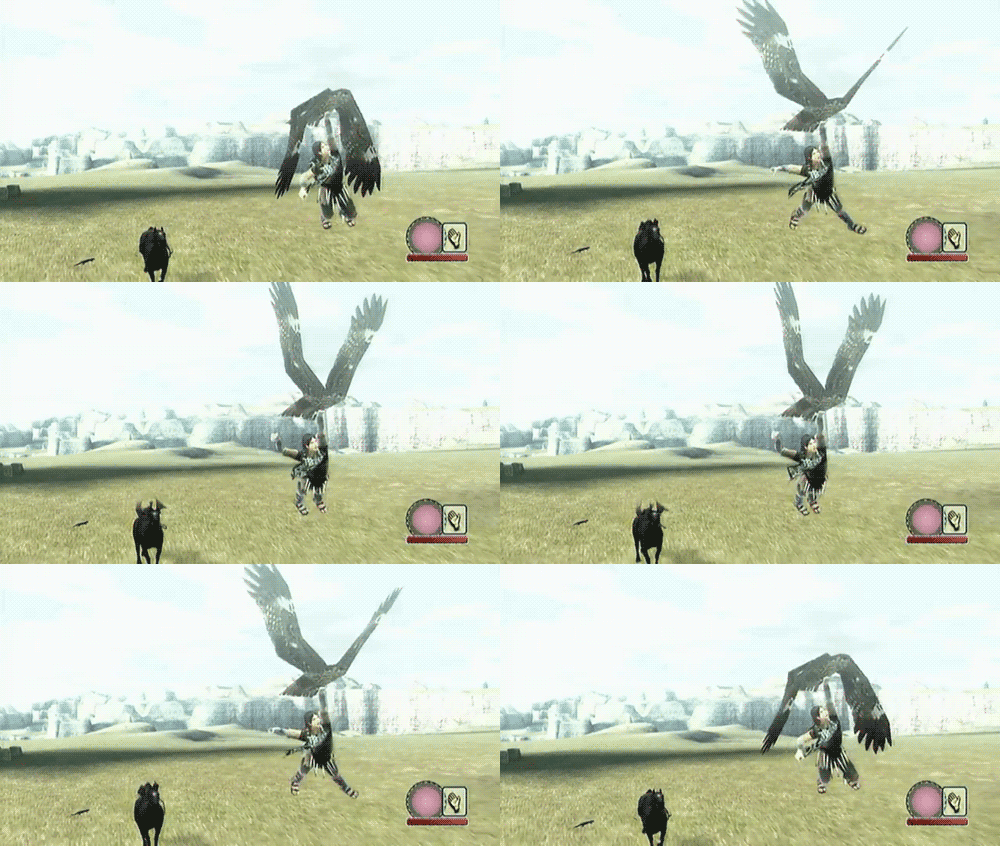
One of the clearest examples that stayed with me is from Shadow of the Colossus. Your stamina drains as you climb, and that simple rule creates powerful tension. Every moment you hold on feels important. If you have too much stamina the tension disappears. If you have too little it turns into frustration.
The game never asks you to focus on exact numbers. It only shows a stamina bar that shifts from blue, meaning safe, to red, meaning danger. This choice is intentional. Players are meant to feel the tension, not calculate it. But behind that simple bar are many carefully tuned values. How many stamina points should move the player into the danger zone? Should stamina drain faster when the colossus shakes? Should it drain slower when the player finds a stable position? Every one of these decisions shapes how the game feels.
Dark Souls taught me another important lesson. Losing souls, which is the in game currency, and having limited healing flasks, which are in game health potions, turns every choice into a high stakes moment. I still remember losing a huge amount of souls and feeling that deep sinking frustration. I also remember the moments where I won a fight with no flasks left. That kind of victory feels incredible because the system creates real pressure.
The economy constantly makes you question your decisions. Should I go into this fight with one flask and ten thousand souls? That hesitation and that mental debate are intentional. The design uses numbers to produce emotion.


Not every game manages to keep this balance. Assassin’s Creed Valhalla is a good example of what happens when numbers start leading the design instead of supporting the experience. The main structure of the game is to level up, clear areas, and move the story forward. If your level is too low, you simply cannot progress. That means you must grind before you can continue the main storyline. The economy keeps scaling without any real emotional purpose and gently pushes players into repetitive loops and paid experience boosts. The systems technically work, but they begin to feel like they are built for monetization rather than for the player’s journey. As time goes on, the sense of progress loses its meaning because the emotional reward is replaced by the pressure to keep up with the numbers.
The lesson here is not that monetization is wrong. The lesson is that the player experience should lead and the numbers should support it. When a game feels meaningful, players naturally want to invest their time or their money.


The lesson here is not that monetization is wrong. The lesson is that the player experience should lead and the numbers should support it. When a game feels meaningful, players naturally want to invest their time or their money.
This is why I always remind myself that game economies are emotional systems first. They may look like simple stamina bars or potion counts, but behind that surface are values shaped to evoke specific feelings. As designers we get to adjust those values and watch how players respond. That is the part that still excites me.
The same thinking applies to casual and mobile games. Energy systems, timers, and boosters are often misunderstood as simple restrictions. In reality they act as pacing tools. They create anticipation, decision moments, and emotional payoffs. Running out of energy, deciding when to use a booster, or saving a rare merge item all shape how players connect to the loop.
The best casual economies turn waiting and spending into meaningful choices instead of frustration. I will talk more about these ideas in future posts.
It often helps to ask simple questions. What if stamina in Shadow of the Colossus never ran out? What if you never lost souls in Dark Souls? What if a mobile game gave infinite energy or boosters? When you remove limits, you also remove tension, anticipation, and the joy of overcoming challenges. Change the economy and you change the emotion.
At the core of good design is a simple idea. Decide what you want the player to feel and then build systems that reinforce that feeling. Make those systems intuitive so players understand them instantly. Give limits a purpose they can sense. Use rewards to create joy instead of inflating numbers. And when you monetize, focus on enhancing what players already enjoy rather than limiting their access to fun.
The core message is simple. Player experience comes before numbers. The spreadsheet is there to support the feeling, not decide it. Start with how the game should feel and then let the numbers earn their place.
Contact
Questions? Reach out anytime.
hello@thegamebalancer.com
© 2025. All rights reserved.